
Musculoskeletal ultrasound is defined by the anatomy being assessed. Sports ultrasound is defined by its application to injuries and medical conditions associated with sport and exercise.
The two overlap. An ultrasound assessment of a runner’s Achilles tendon can be both a musculoskeletal examination and a sports ultrasound examination.
The distinction is useful for clinicians learning ultrasound because it separates two questions: what structures are we examining, and what clinical problem are we trying to address?
In their 2022 multidisciplinary consensus statement, Hall and colleagues proposed definitions to help make communication in musculoskeletal and sports ultrasound more consistent.
What is musculoskeletal ultrasound?
Musculoskeletal or MSK ultrasound uses ultrasound to help diagnose conditions or guide treatment involving muscles, tendons, ligaments, joints, bones, cartilage, nerves, fascia, bursae, and related soft tissues.
Its scope follows the anatomy.
For example, examining an Achilles tendon is an MSK ultrasound application whether the patient is a competitive runner, a recreational walker, or someone who does not participate in sport.
MSK ultrasound applies to athletes and nonathletes.
The definition also includes treatment guidance. MSK ultrasound therefore encompasses both evaluating anatomical structures and using imaging to guide treatment involving those structures.
What is sports ultrasound?
Sports ultrasound is the use of ultrasound by a qualified medical professional to help diagnose or guide treatment of injuries and medical conditions associated with sport and exercise.
Its scope follows the clinical context.
The consensus describes applications in both clinical and field settings. An examination in a sports medicine clinic can fit the definition just as well as an assessment beside a playing field.
Sports ultrasound can also extend beyond the musculoskeletal system. The definition includes medical conditions associated with sport and exercise, rather than limiting its scope to muscles, tendons, and joints.
The patient being an athlete is not, by itself, the defining distinction. The examination’s relationship to sport or exercise matters.
Where do they overlap?
Consider a runner with Achilles pain who undergoes an ultrasound examination.
The assessment fits both descriptions:
MSK ultrasound: the anatomical target is a tendon.
Sports ultrasound: the clinical problem is associated with running.
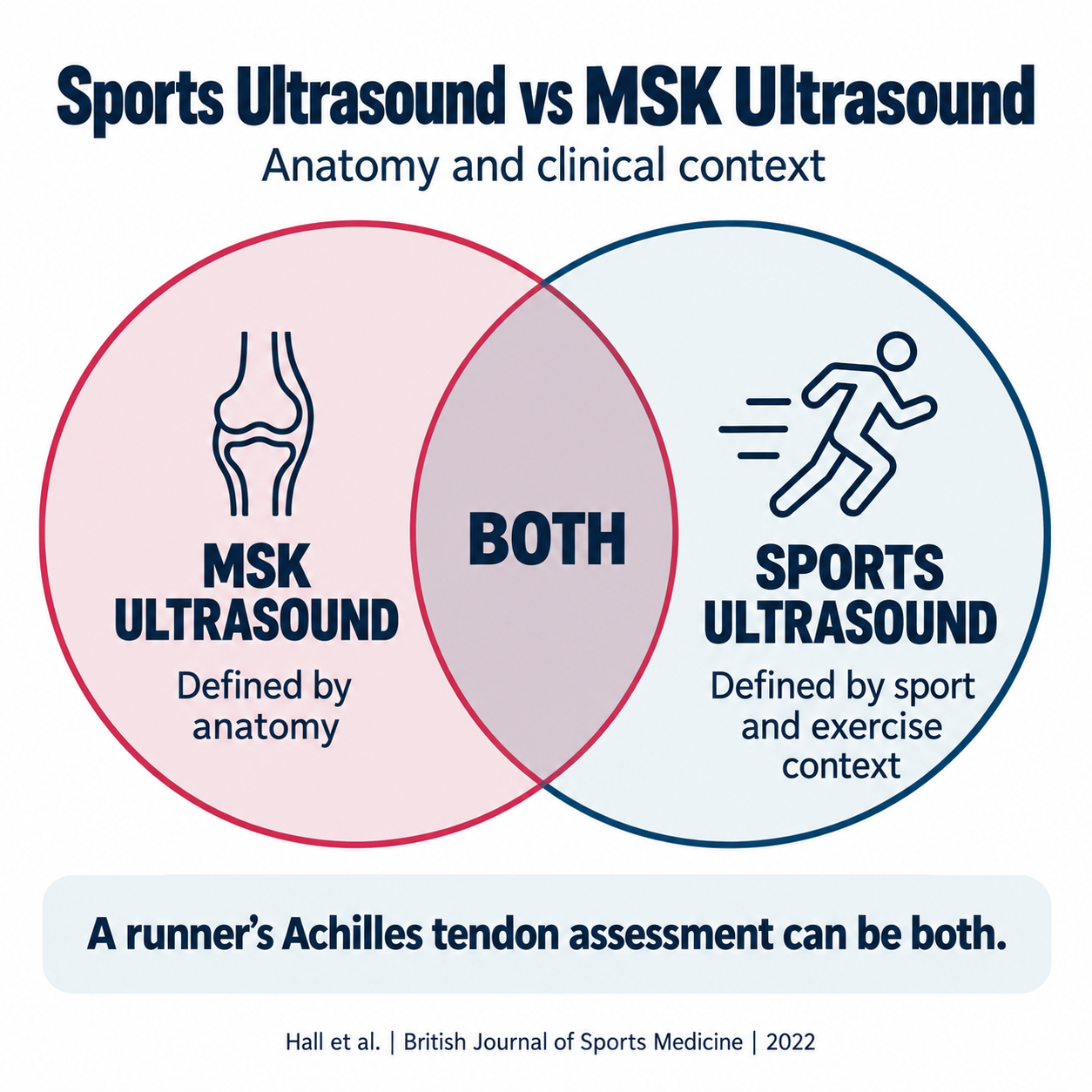
One describes anatomical scope; the other describes clinical context. An examination can fit both definitions.
Now consider an Achilles examination for someone whose symptoms are unrelated to sport or exercise. It remains an MSK ultrasound examination because the anatomical target has not changed.
These are overlapping descriptions of ultrasound use. A single examination can fit both.
Does the equipment determine the terminology?
The distinction in the consensus is based on application rather than a particular ultrasound machine.
A portable system may be useful for field assessment, but portability does not define sports ultrasound. Similarly, performing an examination inside a clinic does not make it exclusively MSK ultrasound.
The terms describe the scope and context of the assessment not a different imaging technology.
The clinical question comes first
For clinicians learning ultrasound, the distinction becomes most useful when it connects to the purpose of the examination.
For an Achilles assessment, a clinical question might be:
“Is the tendon intact?”
That question gives the examination a focus. The findings then need to be interpreted alongside the patient’s history and clinical examination.
The consensus notes that sports ultrasound evaluations often address a specific clinical question and that further imaging or involvement of other imaging experts should be considered when appropriate.
Calling an examination “sports ultrasound” does not establish that it can answer every question about the patient’s symptoms.
A useful distinction for teaching
When introducing these terms, start with two ideas:
MSK ultrasound describes the anatomical scope. Sports ultrasound describes the sport and exercise context.
Then connect them with an example, such as the runner’s Achilles assessment.
This gives learners a practical way to understand the overlap while keeping attention on the structures being assessed, the reason for scanning, and the limits of the examination.
Continue learning with Pura Health
Developing ultrasound skills involves connecting anatomy, image acquisition, and clinical reasoning.
Explore Pura Health’s ultrasound training offerings
Find hands-on education, online learning, and mentorship.
Reference
Hall MM, Allen GM, Allison S, et al. Recommended musculoskeletal and sports ultrasound terminology: a Delphi-based consensus statement. British Journal of Sports Medicine. 2022;56(6):310–319.
Read the original consensus statement
This article explains terminology proposed in a multidisciplinary expert consensus published in 2022.