
For a long time, I have been thinking about the gap between identifying an injury on a scan and deciding what an athlete is ready to do next. Imaging thigh injuries brings that question into focus: an accurate diagnosis matters, but a return-to-sport decision asks more of us.
Listening to Dr Carles Pedret discuss thigh injuries on the SEMS Conference Podcast reinforced several ideas I agree with. In particular, I share his emphasis on understanding the anatomy, interpreting imaging in context and being honest about uncertainty. These are my reflections on that discussion, alongside the research that helps me put it in perspective.
The question I keep coming back to is this: what does this finding change about our understanding of the injury—and what should it change about our next decision?
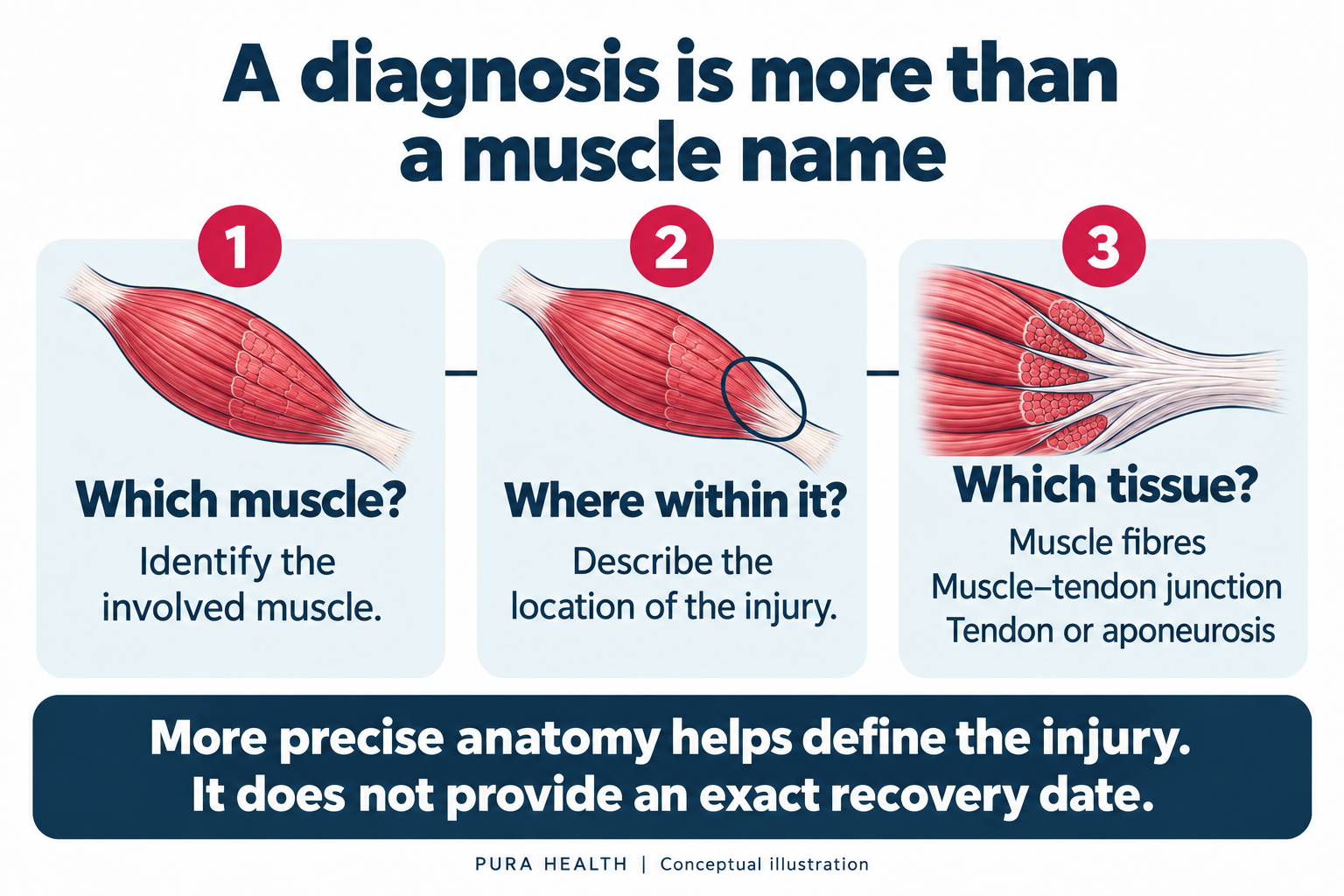
The diagnosis needs to describe the tissue
A label such as “hamstring injury” or “rectus femoris injury” is a starting point. I want the description to go further: which muscle is involved, where the injury sits, which tissues are affected and how the mechanism fits the findings.
That means paying attention to muscle fibres, the muscle–tendon junction, tendons and aponeuroses. Anatomical specificity helps define the problem we are trying to manage. It should not become a promise of a precise recovery date.
Research illustrates that distinction. In a prospective study of acute hamstring injuries, van der Made and colleagues found that intramuscular tendon involvement on MRI had limited value for predicting an individual athlete’s time to return to play. That is a reason to interpret a finding carefully, rather than dismiss it or turn it into a countdown. [1]
The clinical question should guide imaging
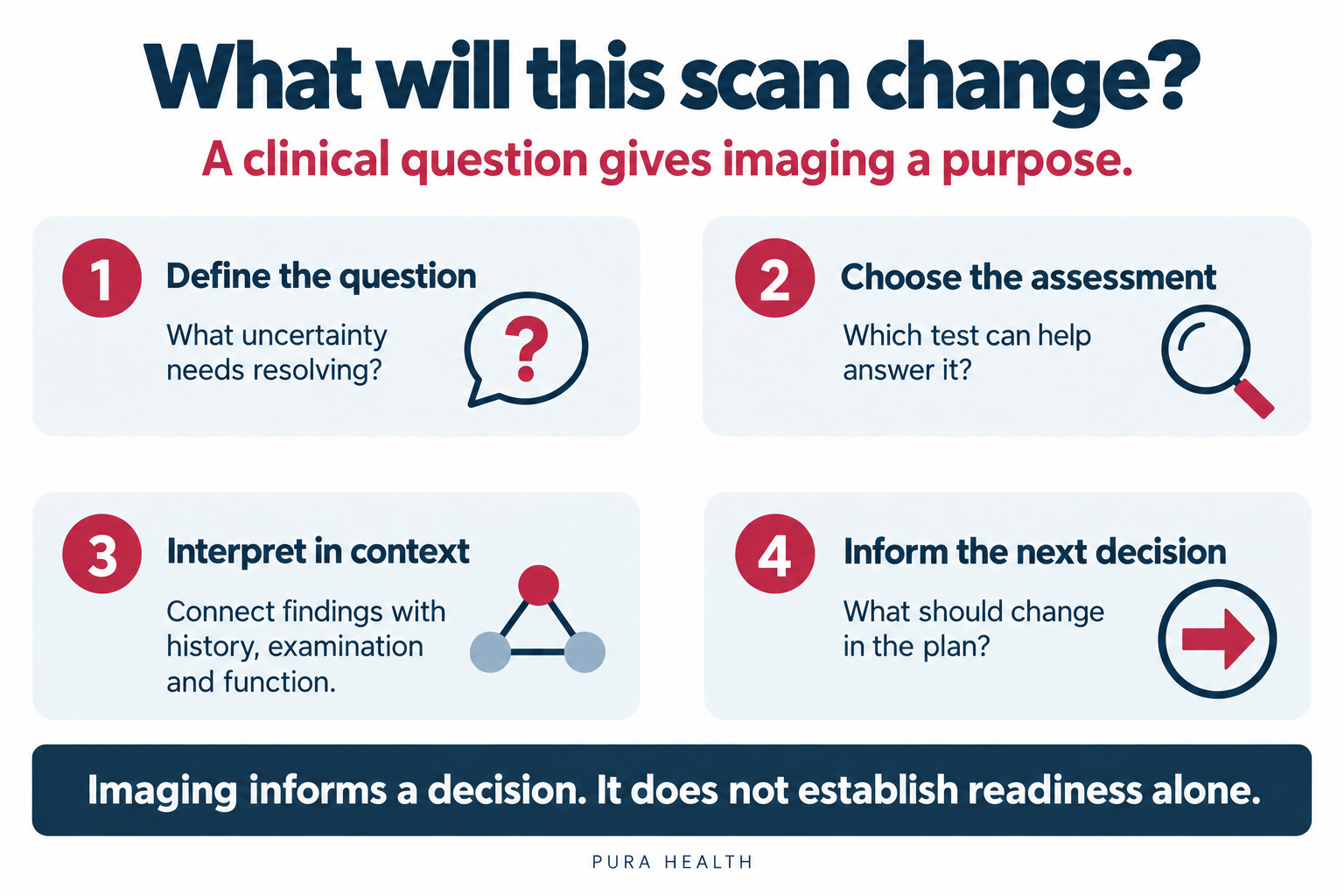
Before deciding which scan to request—or whether to repeat one—I think we should be clear about the uncertainty we are trying to resolve. What information is missing? Can the proposed examination answer that question? Could the result change the plan?
In the podcast, Pedret describes early MRI and ultrasound within his professional-athlete practice, including his emphasis on MRI for assessing dense connective tissue. I see that as a description of his clinical context, rather than a universal timetable for every person with thigh pain.
For me, ultrasound competence includes knowing what the examination can contribute and when another imaging modality or specialist assessment may add useful information. The quality of the interpretation matters as much as obtaining the image.
Feeling better is important, but it needs context
An athlete’s symptoms matter. So does the activity under which those symptoms are assessed. Feeling comfortable with daily tasks does not answer the same question as tolerating the demands of sprinting, kicking or changing direction.
The reverse is also important: an imaging abnormality does not automatically mean an athlete cannot return successfully. Vermeulen and colleagues studied 41 athletes with hamstring intramuscular tendon injuries and found that complete resolution on MRI was not necessary for a clinically successful return to play. [2]
I take that as a reminder to bring the information together. A reassuring symptom report and a persistent imaging finding both need interpretation in the wider clinical picture.
Follow-up imaging should have a purpose
Pedret discusses serial imaging to monitor changes in scar tissue during rehabilitation. I agree with the need to understand how the injury is evolving, while remaining careful about what a scan can establish.
I would not treat scar appearance as a direct measurement of mechanical strength or a validated clearance threshold. Nor would I present a fixed repeat-scan schedule as proven to prevent reinjury.
My question for follow-up imaging is the same as for the initial assessment: what decision could the result change? If that is unclear, the reason for repeating the examination needs more thought.
Readiness involves the whole athlete
My view of readiness brings together the athlete’s symptoms, confidence and goals; the clinical examination; strength and functional progression; the response to loading; and the demands of the sport. Imaging contributes when it can resolve a relevant uncertainty.
The London International Consensus on hamstring rehabilitation supports individualising rehabilitation around the athlete’s sport demands, injury characteristics and required capacities. It also highlights areas where expert agreement remains incomplete. [3]
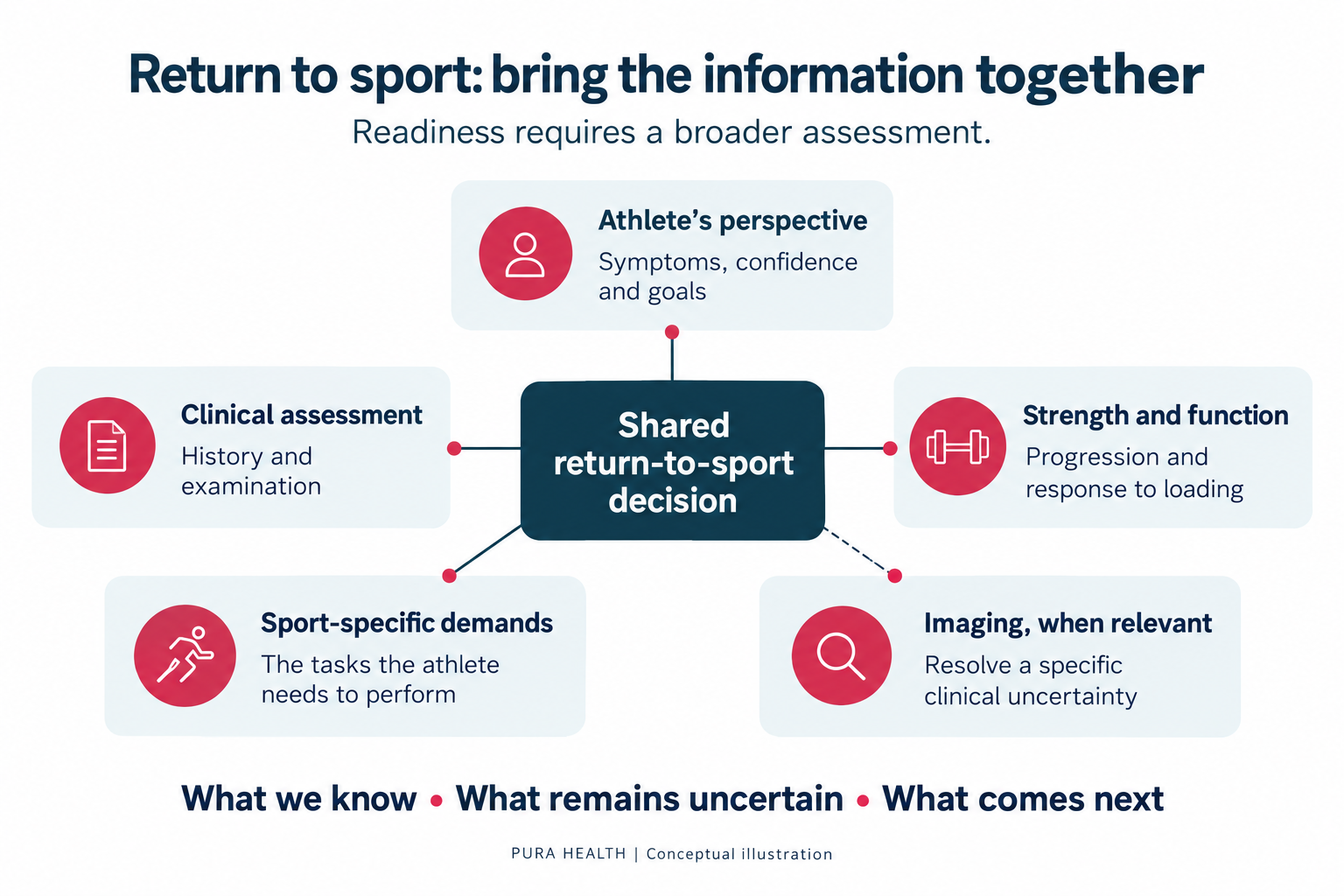
For me, this means resisting the temptation to make one reassuring result carry the whole decision. I want to understand what the athlete has demonstrated, what demands remain ahead and what information we still need.
We need to communicate uncertainty honestly
Return-to-sport discussions happen under pressure. Athletes want to compete, teams have deadlines and everyone would prefer a clear date. I agree with Pedret that an earlier return should not automatically be treated as evidence of better care.
The conversation should make the reasoning visible: what we know, what remains uncertain, which demands have been reintroduced and what the next step involves. The importance of a competition does not make uncertainty disappear.
What this means for ultrasound education
These ideas shape how I think about ultrasound education. Recognising an abnormality is one part of the task. Explaining its possible relevance, recognising the limits of the examination and connecting it to the clinical question are equally important.
That is why anatomy and clinical reasoning belong together. Accurate diagnosis helps define the problem. Readiness requires us to understand the athlete’s response to the demands ahead.
If you want to develop your MSK ultrasound skills alongside clinical reasoning, explore Pura Health’s courses and mentorship.
Explore courses and mentorship
Sources and further reading
Podcast discussion: Carles Pedret on Accurate Diagnosis of Thigh Injuries, SEMS Conference Podcast (2026). This article presents my perspective on themes raised in that discussion; the diagrams are conceptual illustrations, not validated return-to-sport protocols.